
Introduction
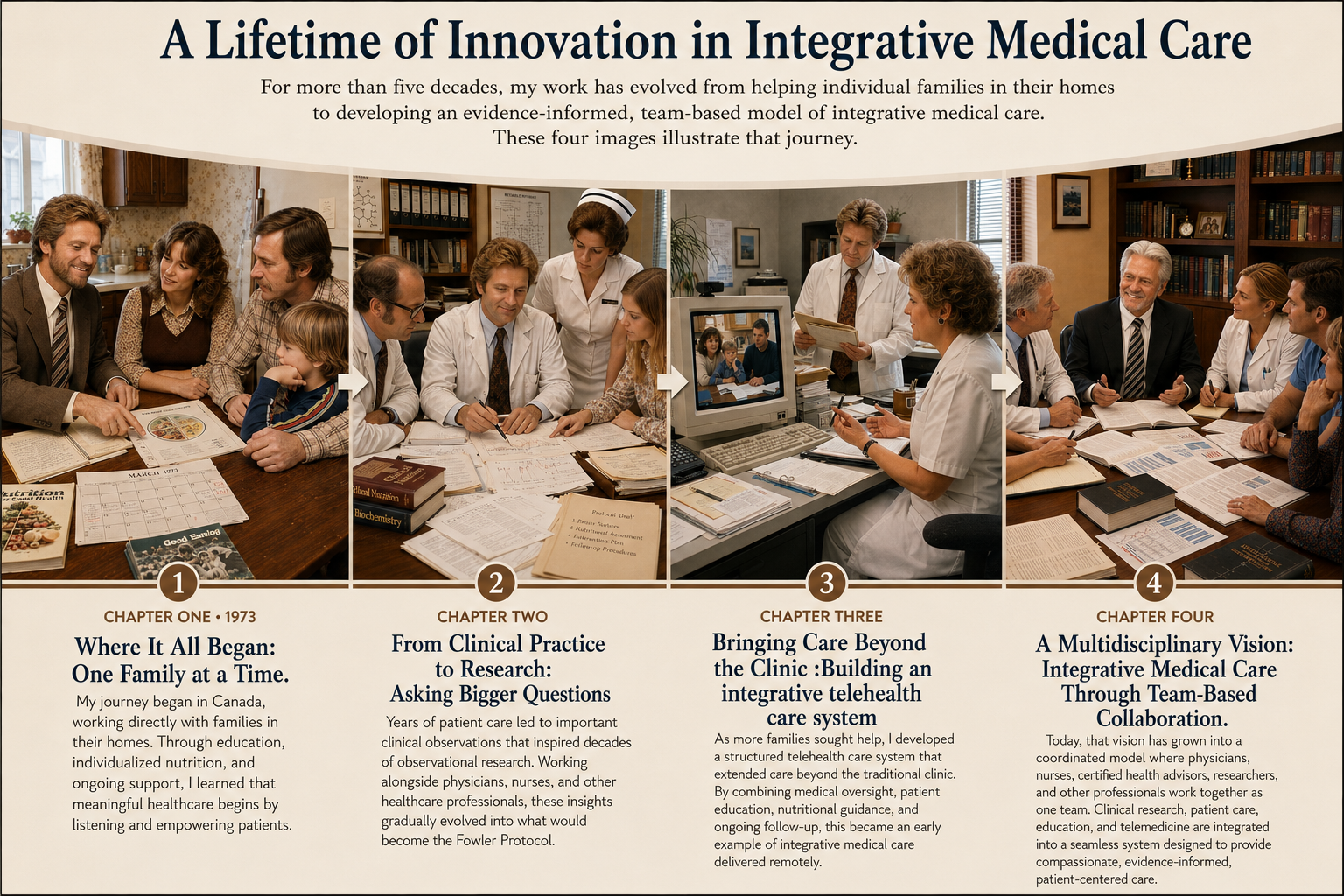
Vincent Fowler is an advocate for integrative medicine who successfully bridged the divide between conventional and holistic models of care. He is a citizen scientist, entrepreneur, healthcare researcher and innovator who has dedicated more than five decades to advancing clinical research and human nutrition. Throughout his career, he has pioneered the development of an Integrative Community-based TeleHealth and Care Delivery System across Canada and throughout the United States, helping to expand access to care and establish innovative models of patient healthcare.
His work has included specialized research and developing clinical treatment programs involving enuresis, fibromyalgia syndrome and type 2 diabetes. While exploring the complex relationships between nutrition, inflammation, immune function and long-term health outcomes, Vincent has served in leadership, administrative and advisory roles with healthcare organizations, research institutions and academic programs, including contributions to research development and funding initiatives. His career has been characterized by a commitment to evidence-informed healthcare innovation, the advancement of integrative medicine, and the development of practical solutions designed to improve the health and well-being of individuals and communities.
Career
Throughout his career, Vincent Fowler has held leadership, administrative, advisory, consulting and executive positions within a variety of respected healthcare, research, academic, pharmaceutical, medical and healthcare organizations. His work has included appointments and collaborations with institutions located at the University of Western Ontario Research Park, Windsor Regional Hospital, the Canadian Children's Centres, Family Health Service, and as special advisor to the Human Nutraceutical Research Unit at the University of Guelph. In these roles, he contributed to research development, organizational leadership, healthcare innovation and funding initiatives, including assisting in securing research support through the National Research Council of Canada.
He has also served as a consultant to the pharmaceutical, medical and healthcare industries, providing strategic guidance in patient care, clinical research, healthcare technology and organizational development. Frequently serving in dual capacities as Executive Director and Administrator of Clinical Research and Development, Vincent played a central role in fostering innovation, advancing transparent and independent clinical research, and implementing integrative healthcare practices. His leadership in human nutrition and health research contributed to the design, development, testing and refinement of a Remote, Integrative, Decentralized, Community-Based Healthcare System that was validated through the participation of approximately 10,000 patients.
Fowler's career has been distinguished by his expertise in navigating the complexities of federal, state and provincial governmental regulations, as well as academic, medical and community-based guidelines. His collaborative approach, combined with a longstanding commitment to advancing human health, has enabled him to work effectively with institutions, researchers, healthcare professionals, industry leaders and community organizations in pursuit of meaningful improvements in healthcare and scientific understanding.
Entrepreneurship, research and innovation
Fowler founded and funded the development of one of the earliest telemedicine clinic models offering integrative medicine treatments, specializing in a remedy for enuresis (bedwetting). In 1973, through the establishment of the Canadian Children's Centres, he created a research clinic dedicated to studying and treating enuresis and assembled a multidisciplinary team of researchers, scientists and clinicians. As executive director, administrator of research and development, and business administrator, he directed an extensive review of the best available evidence-based literature on enuresis, developed proprietary nutrition-based treatment interventions, and designed standardized treatment protocols that were delivered across Canada and throughout the United States.
He also designed and developed the technology for a Central Remote Patient Care Management system and networked it to multiple cities, allowing standardized evidence-based treatment to be offered internationally. In addition, he developed the marketing strategy and fee-for-service business model that supported the sustainability of the Centre's operations while enabling continued self-funded research.
During a period of more than twenty years, Fowler continued funding his R&D team and conducted independent observational clinical research involving thousands of enuretic patients. Through extensive clinical assessment, data collection and long-term analysis, he identified a significant discovery: in a subset of patients, successful treatment of enuresis was associated with the improvement or alleviation of several seemingly unrelated chronic health conditions, including asthma, ADD/ADHD, non-specific leg pains and other chronic symptoms. This observation suggested that targeted integrative interventions could influence broader physiological systems beyond the initial diagnosis and became a pivotal turning point in the evolution of Fowler's research.
Realizing his discovery would require further research and evidence, in 2000 Fowler funded the formation of three new not-for-profit organizations: Cutler Research Group, Cutler Pharmaceutical and Cutler Clinics. These organizations, collectively operating as the Cutler Research Consortium, were established to create a collaborative environment that could stimulate innovation and support the investigation of whether the therapeutic approaches pioneered for enuresis could be successfully applied to complex degenerative diseases. The Cutler Group's new focus became the development of treatment protocols for fibromyalgia syndrome (FMS) and irritable bowel syndrome (IBS).
After a thorough review of thousands of scientific studies, Fowler and the Cutler team identified that fibromyalgia syndrome had no clearly established cause, no consistently reliable diagnostic method, and no standardized treatment protocol. The team subsequently designed and developed a proprietary diagnostic instrument for FMS, and Fowler developed treatment protocols for FMS and IBS built on a compilation and analysis of the best available scientific evidence from national and international groups of experts. The introduction of Cutler's proprietary diagnostic instrument also provided a framework that facilitated the subsequent development and commercialization of pharmacological treatments for fibromyalgia syndrome by multiple pharmaceutical companies.
Fowler also followed clinical guidance including The Fibromyalgia Syndrome: A Clinical Case Definition for Practitioners (2003), a document supported by Health Canada. Building from this body of evidence, he designed and developed complex treatment regimens for fibromyalgia syndrome and irritable bowel syndrome using a multidisciplinary and integrative model of care.
He then designed and developed (a) a telemedicine research clinic specializing in treatments for FMS and IBS; (b) technology for a new Central Remote Patient Care Management (RPCM) system to administer the treatments; (c) technology for a state-of-the-art Medical Record System enabling Integrative Medical Teams to collaborate; and (d) evidence-based, patient-centred complex treatment regimens. This work contributed to the development of the Integrative Telemedicine Healthcare Research System (ITHRS), a technology-enabled framework designed to integrate science, remote patient monitoring, clinical research, medical records and multidisciplinary care.
In 2017 he founded and funded Cutler Health Technologies (CHT) and amalgamated his prior organizations into one technology-focused enterprise, creating a telemedicine practice-based integrative medicine platform for complex illness. After years of successfully treating enuresis and fibromyalgia, a pivotal trend was identified: type 2 diabetes patients in care showed significant improvement. Based on five decades of data collection involving thousands of patients, the team refined proprietary treatment protocols and proprietary technologies, including a telehealth system with remote patient monitoring for type 2 diabetic patients.
Following five more years of research and development, he completed the design of the technology necessary for a 24/7 virtual medical clinic with Remote Patient Care for the treatment of multiple chronic medical conditions — including scalable operating systems, remote patient care technologies, collaborative medical records, clinician support infrastructure and advanced telemedicine systems. Throughout his career, Fowler has advocated for an evidence-based Integrative Medicine model that combines conventional healthcare with scientifically supported complementary approaches.
Collaborations & acknowledgements
Recognizing that health and illness are influenced by physical, psychological, emotional, social and environmental factors, these treatment protocols incorporate evidence-based conventional medicine alongside evidence-based holistic therapies such as clinical nutrition, dietary interventions, targeted supplementation, exposure to natural solar cycles ("solar metronomes"), electromagnetic field therapy, structured water, physical exercise, breath work, meditation and yoga. Because this program combines several different treatment approaches, it is supported by a multidisciplinary team of professionals who work together to guide, coordinate and oversee patient care.
Considerable gratitude is owed globally to the thousands of dedicated researchers and clinicians in numerous universities, governmental agencies and other institutions for the scientific studies and contributions from which these treatment protocols were adopted. Special gratitude is extended to esteemed institutions such as Harvard, Stanford, the University of Arizona and many others that offer integrative medicine programs, as well as UCSF, Duke, Georgetown, Michigan, Minnesota and Maryland — along with the University of Toronto and McGill in Canada, Charité University in Berlin, the University of Westminster in the UK, the Karolinska Institute in Sweden and the Sackler Faculty of Medicine at Tel Aviv University.